Operational AI

AI for Saudi Restaurants: Operational Efficiency and Customer Experience in KSA

Saudi restaurants face unique operational challenges, from managing fluctuating demand to optimizing supply chains. This article details practical AI applications to improve efficiency and customer satisfaction, grounded in the KSA context.

AI-powered digital menu interface in a modern Saudi restaurant setting, showcasing personalized recommendations and efficient ordering.

Saudi Arabia's restaurant sector is booming, driven by Vision 2030's focus on tourism and entertainment. However, this growth brings intense competition, rising operational costs, and increasing customer expectations. Many restaurant owners in the KSA struggle with inconsistent inventory, high staff turnover, and the challenge of delivering a consistently excellent customer experience across multiple locations. Generic solutions often fail to account for local supply chain nuances or specific consumer preferences. The question isn't if AI can help, but how to implement it effectively within the Saudi operational reality to address these specific pain points.

01

KSA Restaurant Landscape: Operational Hurdles and AI Opportunities

The Saudi restaurant industry is experiencing rapid expansion, fueled by increased domestic spending and a growing influx of tourists. This growth, while positive, places significant pressure on operational efficiency. Businesses are grappling with rising labor costs, intricate local supply chains that demand precise forecasting, and the imperative to meet evolving digital expectations from customers who are increasingly tech-savvy and accustomed to seamless service.

Navigating these challenges requires more than traditional management methods. For instance, managing perishable inventory in a climate like Saudi Arabia, coupled with fluctuating demand tied to local events or seasons, can lead to substantial waste and lost revenue. Furthermore, the drive for Saudization mandates optimizing workforce deployment and training, making efficient scheduling and task allocation critical for compliance and profitability.

AI offers a pathway to address these specific operational bottlenecks. Instead of broad, theoretical applications, we focus on tangible use cases that directly impact the bottom line and customer satisfaction within the KSA context. This includes everything from predicting demand for specific menu items based on local events to optimizing delivery routes within congested city centers like Riyadh or Jeddah, ensuring that technology serves the business's unique needs rather than becoming another overhead.

Chef in a modern Saudi kitchen reviewing an AI-generated inventory report on a tablet, highlighting efficiency in back-of-house operations.
02

Front-of-House AI: Enhancing Customer Experience in Saudi Restaurants

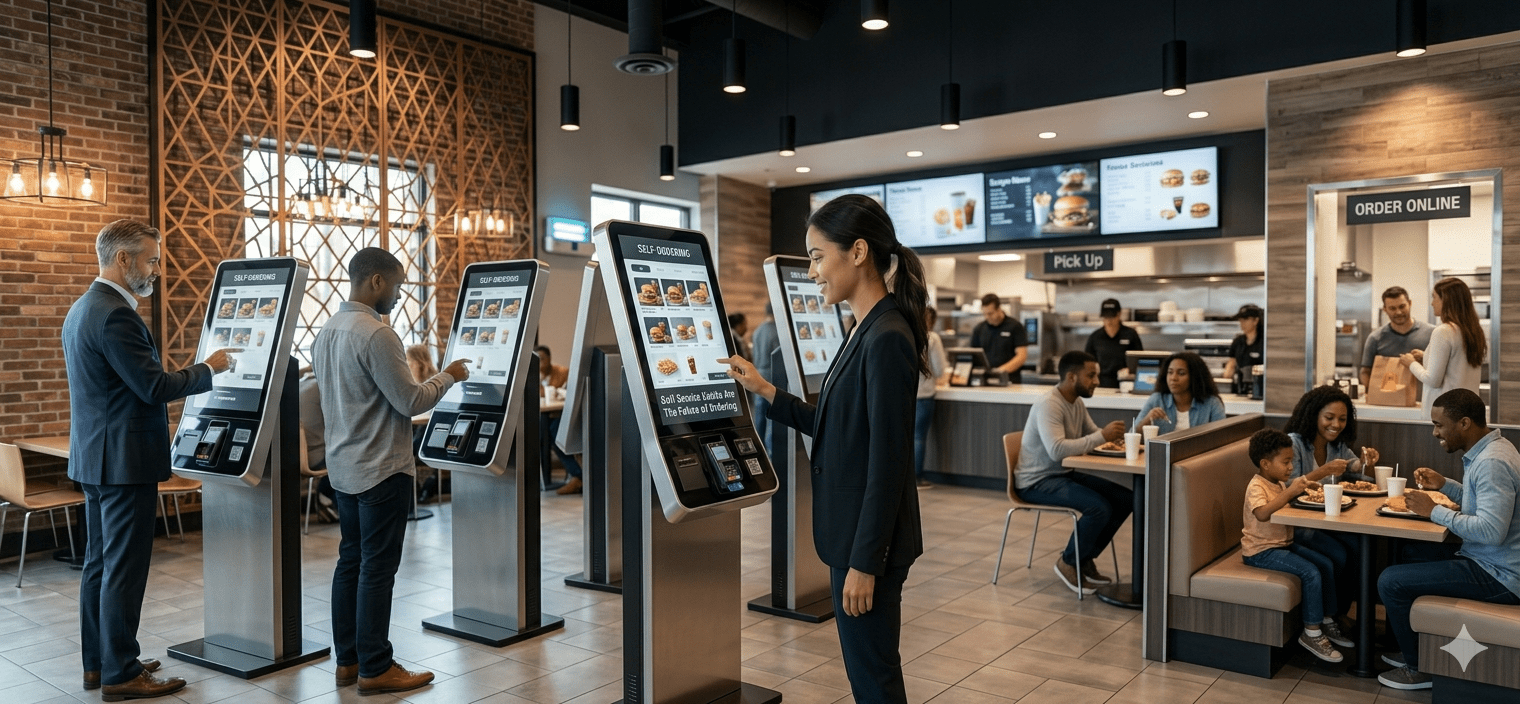
In the competitive Saudi restaurant market, customer experience is paramount. AI can significantly elevate front-of-house operations by streamlining ordering processes and personalizing interactions. Imagine AI-powered kiosks or tablet menus that not only take orders but also suggest popular dishes or offer customized recommendations based on past purchases and dietary preferences, all while being available in both Arabic and English.

Beyond ordering, AI can optimize table management and reduce wait times, a common frustration for diners during peak hours. Systems can predict table turnover rates with high accuracy, allowing hosts to manage reservations and walk-ins more efficiently. This proactive approach minimizes customer dissatisfaction and ensures a smoother flow, particularly in high-volume establishments in areas like the Boulevard Riyadh City.

Another critical application is AI-driven customer feedback analysis. Instead of relying solely on manual reviews, AI can process natural language feedback from various platforms—social media, review sites, and in-house surveys—to identify recurring issues or commendations. This provides actionable insights into service quality, food consistency, and ambiance, enabling swift operational adjustments that resonate with Saudi customer preferences and cultural expectations.

03

Back-of-House Optimization: AI for Supply Chain and Inventory

The true operational backbone of any restaurant lies in its back-of-house efficiency, and AI offers substantial improvements here. For Saudi restaurants, managing inventory and supply chains is particularly complex due to import dependencies and local market fluctuations. AI-powered inventory systems can predict demand for specific ingredients with remarkable accuracy, minimizing waste and ensuring optimal stock levels, which is crucial for perishable goods in a warm climate.

These systems integrate historical sales data, seasonal trends, and even local event calendars to forecast ingredient needs, preventing both overstocking and stockouts. For instance, an AI model can anticipate a surge in demand for lamb during Eid al-Adha or seafood during coastal festivals, adjusting procurement orders accordingly. This precision directly impacts profitability by reducing spoilage and optimizing purchasing power.

Furthermore, AI can streamline workforce management, a significant operational cost. Intelligent scheduling algorithms can optimize staff deployment based on predicted customer traffic, employee availability, and skill sets. This ensures adequate staffing during peak hours without over-scheduling during slower periods, leading to reduced labor costs and improved employee satisfaction, all while adhering to Saudization targets and labor laws.

A customer using an AI-enabled self-ordering kiosk in a bustling Saudi restaurant, demonstrating improved front-of-house efficiency.
04

Data-Driven Decisions: AI for Menu Engineering and Customer Insights

Effective menu engineering is a critical driver of restaurant profitability, and AI provides the analytical power to move beyond intuition. By analyzing sales data, ingredient costs, and customer feedback, AI can identify which dishes are most profitable, which are popular but low-margin, and which should be removed or reformulated. This allows Saudi restaurants to optimize pricing strategies and menu composition for maximum revenue.

Beyond individual dishes, AI can uncover deeper customer insights. It can segment customer bases by preferences, spending habits, and visit frequency, enabling highly targeted marketing campaigns. For example, an AI system might identify a segment of customers who frequently order traditional Saudi dishes and respond well to promotions during national holidays, allowing for personalized offers that drive repeat business.

This level of data analysis also extends to understanding customer sentiment and trends. AI can track mentions of specific menu items or service aspects across online platforms, providing real-time feedback on new offerings or operational changes. This proactive insight allows restaurant operators to adapt quickly to market demands and maintain a competitive edge, ensuring their offerings remain relevant and appealing to the Saudi consumer.

05

Implementing AI in Your Saudi Restaurant: An Audit-First Approach

Adopting AI in a Saudi restaurant environment requires a strategic, phased approach, starting with a thorough operational audit. Before investing in any technology, it's crucial to understand your current workflows, identify specific pain points, and quantify the potential impact of AI. This initial <a href="/audit">AI Transformation Audit</a> helps define clear objectives and ensures that AI solutions are tailored to your unique operational context, rather than being generic deployments.

Following the audit, a pilot program or <a href="/validation">Validation Sprint POC</a> is essential. This involves implementing AI in a controlled environment, perhaps a single restaurant location or a specific operational area like inventory management. This allows for real-world testing, data collection, and refinement of the AI model to ensure it performs effectively within your existing systems and integrates seamlessly with tools like ZATCA-compliant POS systems.

Scalability and integration are key considerations for any AI deployment in the KSA. The chosen AI solutions must be able to grow with your business and integrate with existing ERP or CRM systems without disrupting daily operations. Our approach focuses on building <a href="/use-cases">Operational AI Use Cases</a> that are robust, maintainable, and provide measurable ROI, ensuring that the technology genuinely enhances your business rather than adding complexity. <a href="/contact">Talk to Ting</a> to discuss how we can help.

Key takeaways

  • Prioritize an operational audit before any AI investment to identify specific pain points and quantify potential ROI in your Saudi restaurant.
  • Implement AI in front-of-house operations to personalize customer interactions and optimize table management, directly impacting satisfaction.
  • Leverage AI for back-of-house functions like inventory forecasting and staff scheduling to reduce waste and control labor costs effectively.
  • Use AI-driven analytics to refine menu engineering and gain actionable customer insights, leading to more profitable offerings.
  • Start with pilot programs (POCs) to validate AI solutions in a real-world Saudi restaurant setting before full-scale deployment.

Frequently asked

How can AI improve customer service in Saudi restaurants?

AI enhances customer service by enabling personalized recommendations through AI-powered menus, optimizing table management to reduce wait times, and analyzing customer feedback from various sources to identify and address service issues proactively. This leads to a more efficient and tailored dining experience, aligning with Saudi customer expectations for high-quality service.

What are the most effective AI tools for inventory management in KSA food businesses?

Effective AI tools for inventory management in KSA food businesses leverage predictive analytics to forecast demand based on historical sales, seasonal trends, and local events. These tools integrate with POS and supply chain systems to automate ordering, minimize waste of perishable goods, and optimize stock levels, directly addressing the complexities of local supply chains.

Is AI cost-effective for small to medium-sized restaurants in Saudi Arabia?

Yes, AI can be cost-effective for small to medium-sized restaurants in Saudi Arabia, especially when implemented strategically. Starting with targeted AI solutions for specific pain points, such as inventory optimization or staff scheduling, can yield significant savings in waste reduction and labor costs, providing a clear ROI. The key is a phased, audit-first approach to ensure the investment aligns with business needs.

How does AI help with ZATCA compliance for restaurant operations?

While AI does not directly handle ZATCA compliance, it can significantly support it by ensuring accurate and timely data for invoicing and reporting. AI-powered POS systems can streamline transaction recording, inventory tracking, and sales analysis, providing the precise data required for ZATCA-compliant e-invoicing. This reduces manual errors and improves the overall integrity of financial records.

Related from Ting

Related from Ting

A detailed infographic illustrating the various cost components of AI implementation for Saudi enterprises, including data, talent, infrastructure, and integration.

Unpacking the True Cost of AI for Saudi Enterprises: Beyond the Initial Investment

Many Saudi enterprises see the promise of AI but underestimate its full cost. This article breaks down direct and hidden costs, offering a practical framework for calculating ROI and optimizing AI spend within the KSA context.

A modern cityscape of Jeddah, Saudi Arabia, with digital overlays representing AI and data streams, symbolizing enterprise AI transformation.

Navigating the AI Landscape: Choosing an AI Company in Jeddah for Enterprise Transformation

Selecting an AI partner in Jeddah requires more than just technical prowess; it demands a deep understanding of KSA's regulatory landscape, operational realities, and Vision 2030 objectives. This guide helps COOs make informed decisions.

Modern cityscape of Jeddah, Saudi Arabia, with digital overlays representing AI and data, symbolizing the city's growth in technology and innovation.

Choosing an AI Company in Jeddah: A Strategic Guide for KSA Enterprises

Selecting the right AI partner in Jeddah is critical for KSA enterprises. This guide cuts through the hype, focusing on actionable criteria for operational AI implementation, data compliance, and measurable business outcomes.