AI Solution Validation
Implementation-ready scope, architecture & cost
- Executive Summary
- Technical Architecture
- ER Diagram
- Budget & Timeline
GoRecommendation
A Ting POC turns your idea, audit finding, or business requirement into an implementation-ready document — feasibility, architecture, ER diagram, integrations, third-party costs, infrastructure, timeline, budget, risks, and a clear Go / No-Go recommendation.
Before Ting builds any AI solution, we document the scope, architecture, costs, systems, data, timeline, and risks. The POC protects both sides from unclear scope, hidden costs, and bad build decisions.
Run a POC when the scope, feasibility, cost, or technical requirements aren't clear yet. It can happen directly, or after an AI Audit.
You have an AI idea but the scope isn't clear yet
You completed an AI Audit and want to validate one opportunity
You need the real build cost before approving implementation
The solution depends on third-party APIs, internal systems, or client data
You need architecture, an ER model, integrations, and data requirements first
You want to avoid scope creep, unclear responsibilities, and hidden costs
Each POC document defines the business scope, validates the technical path, and clarifies the commercial requirements before implementation.
What the solution is, who uses it, and what's included.
Whether it can be built and what systems it needs.
Cost drivers, timeline, resources, and the decision.
Real technical thinking — defined, validated, and scoped, not just described.
A structured definition-and-validation process that produces the POC document. No prototype build, no guesswork.
We review the idea, systems, and goal.
Initial solution contextWe ask the questions that define the solution.
Requirements & assumptionsWe validate feasibility, architecture, and risks.
Technical decision pathWe set scope, budget, timeline, and dependencies.
Commercial clarityA decision-ready scope to approve the build.
Go / Revise / No-GoThree honest outcomes — every one of them saves you from a bad build.
Ready for implementation pricing.
Scope, architecture, and requirements are clear.
Promising, but something needs adjustment.
Usually scope, data, integrations, or budget.
Not ready to build yet.
Cost, risk, missing data, or unclear value rules it out.
No implementation starts without an approved POC document.
If it connects to your systems, data, or customers, we can scope it.
Sales, support, booking, commerce, and customer communication.
Employees, operations, documents, reporting, and decisions.
Systems that need integration, automation, or data movement.
The audit finds opportunities. The POC defines and scopes one of them. Implementation only happens after an approved POC — directly, or after an audit.
Find the AI opportunities
Define & scope one opportunity
Build the validated solution
Maximize long-term value
Direct path — you already know the solution, so you start with a POC.
Audit path — the audit surfaces opportunities first, then the POC validates one.
No. It's a Solution Validation Sprint that produces a POC document — it does not include implementation or a prototype build unless separately agreed.
No. You can start directly if you already know the solution idea. The audit is used when opportunities are unclear or there are several to compare.
Yes — if the outcome is Go (or Revise after adjustments). Implementation is priced separately, from the approved scope.
Ting's POC is prepared for Ting-led implementation unless otherwise agreed. If you need it vendor-neutral, raise it up front so we can scope it that way.
The idea or audit finding, your current workflow, the systems involved, and access to the people who own the data and the decision.
Most POC documents are delivered within days of the POC session, depending on how much technical clarification is needed.
Yes. We identify the required APIs and estimate setup, subscription, and usage costs so there are no surprises later.
It includes a build budget range and timeline. The fixed implementation quote is prepared from the approved scope.
One edit/revision is included. Additional edits are 129 SAR per edit.
Building without a defined scope, architecture, data model, and cost is how projects overrun. The POC protects both sides.
Get the scope, architecture, cost estimate, and Go / No-Go recommendation before committing to implementation.
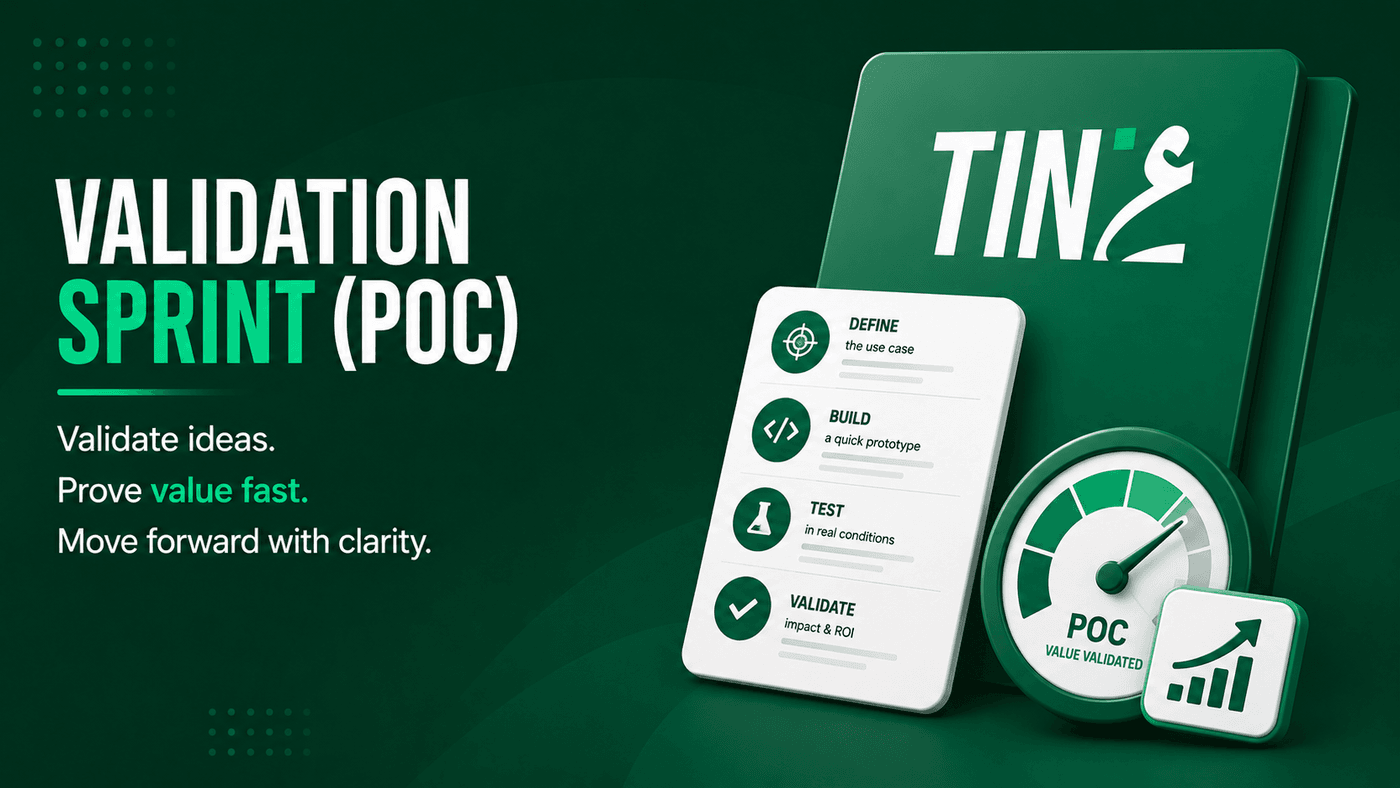
Delivered through Ting's Solution Validation Sprint — we validate the scope, technical feasibility, architecture, estimated budget, timeline, and implementation requirements before any build.
Start POC – 5,000 SAR